Highlighting My Favorite Artists: Francisco Goya
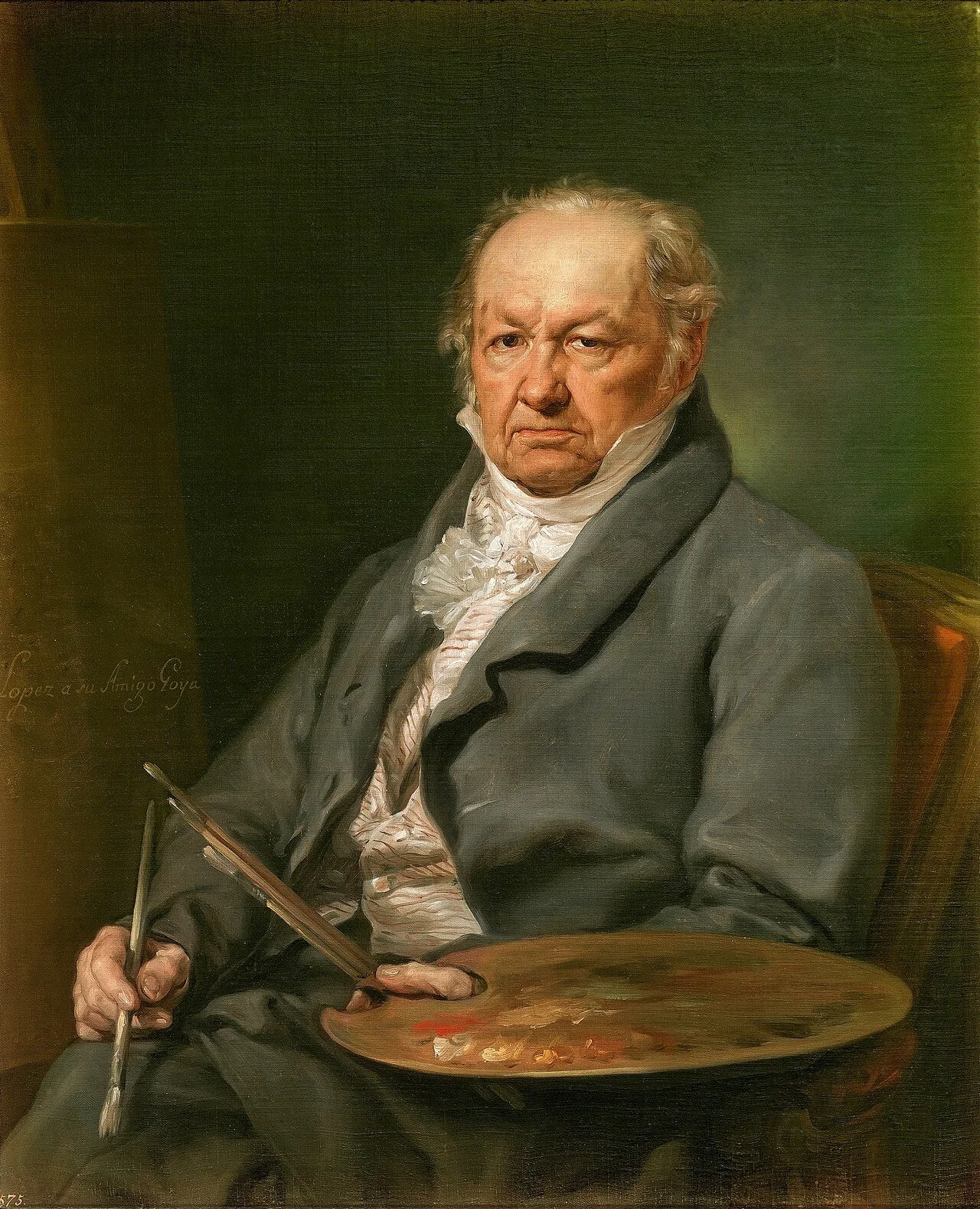
Portrait of Goya by Vicente López (1826)
Francisco Goya was a Spanish romantic painter and printmaker. Considered the most important Spanish artist of the late 18th and early 19th centuries, he is regarded as the last of the Old Masters and the first of the moderns. Throughout his life, he produced paintings, drawings, and engravings that reflected contemporary historical upheavals and influenced major 19th- and 20th-century painters.
Goya was born in 1746 in Fuendetodos, Aragon, to a middle-class family. At age 14, he studied painting under José Luzán y Martínez and moved to Madrid to study with Anton Raphael Mengs. Goya became a court painter to the Spanish Crown in 1786. The early portion of his career is marked by portraits of Spanish aristocrats and royalty, as well as Rococo-style tapestry cartoons for the royal palace.
The atmosphere of his work changed in 1793 after he suffered a severe undiagnosed illness that left him deaf. His later paintings, prints, and drawings reflect a bleak outlook at personal, social, and political levels, in contrast to his social climbing.
My introduction to his work was in my junior year of high school, where we studied Spanish-speaking artists. Here, I will showcase three of my favorite Goya works.
Third of May 1808 (1814)
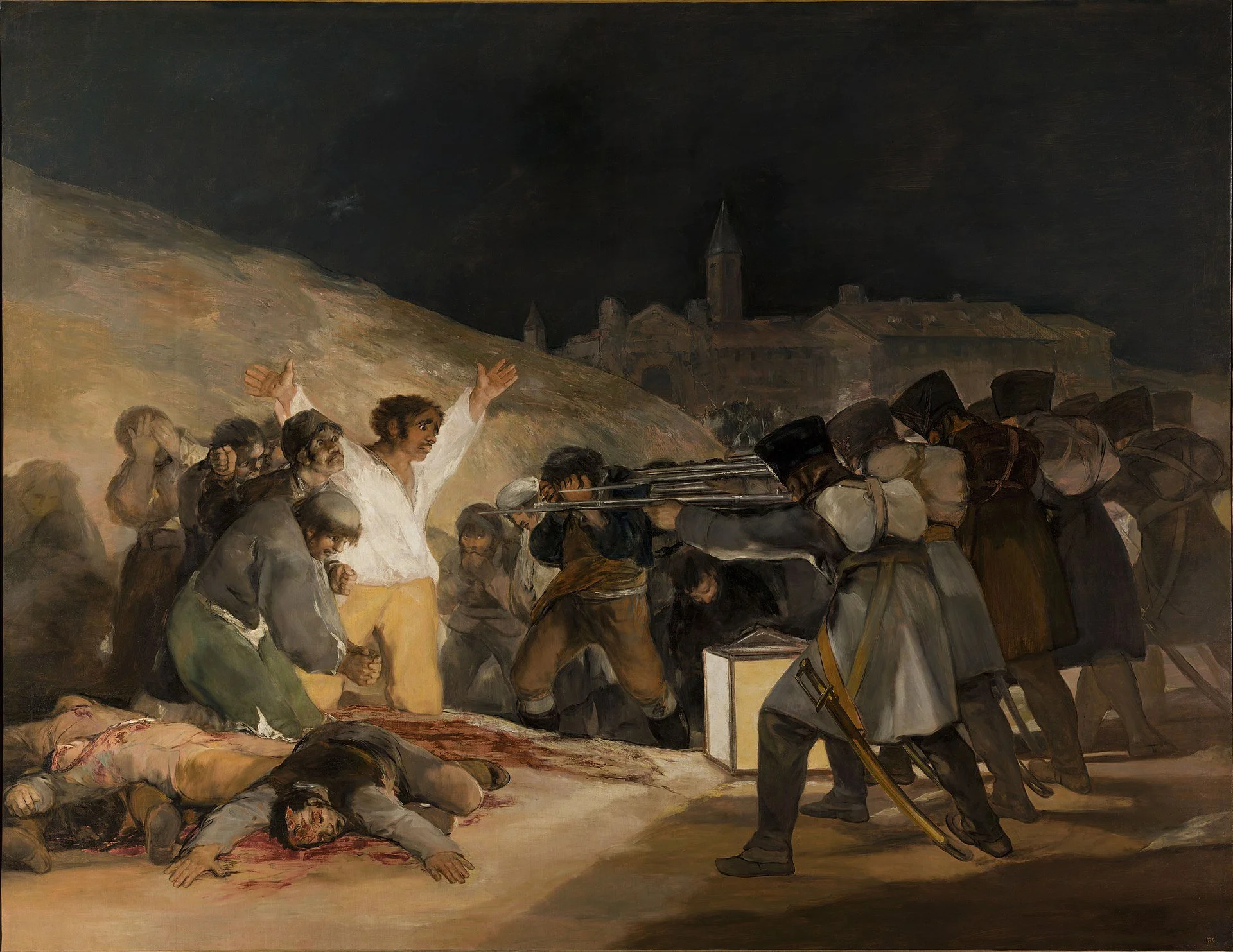
Third of May 1808
The Third of May 1808 was completed in 1814 by Francisco Goya and is now in the Museo del Prado, Madrid. In the work, Goya sought to commemorate Spanish resistance to Napoleon's armies during the occupation of Madrid in 1808 at the start of the Peninsular War. Along with its companion piece of the same size, The Second of May 1808 (or The Charge of the Mamelukes), it was commissioned by the provisional government of Spain at Goya's own suggestion shortly after the ousting of the French occupation and the restoration of King Ferdinand VII.
The emotion Goya captures through his use of color, lighting, and composition is what drew me towards it. We focus on the terrified faces of unarmed civilians, while we see little of the French soldiers who remain uniform, facing away from the viewer. To them, it is routine. One particular subject in the painting I would like to highlight is the man in the white shirt. While he is compositionally positioned as a “martyr”, especially noted with the wounds on his hand resembling Christ’s stigmata, his expression and posture is innate human- he doesn’t want to die.
Saturn Devouring His Son (1823)
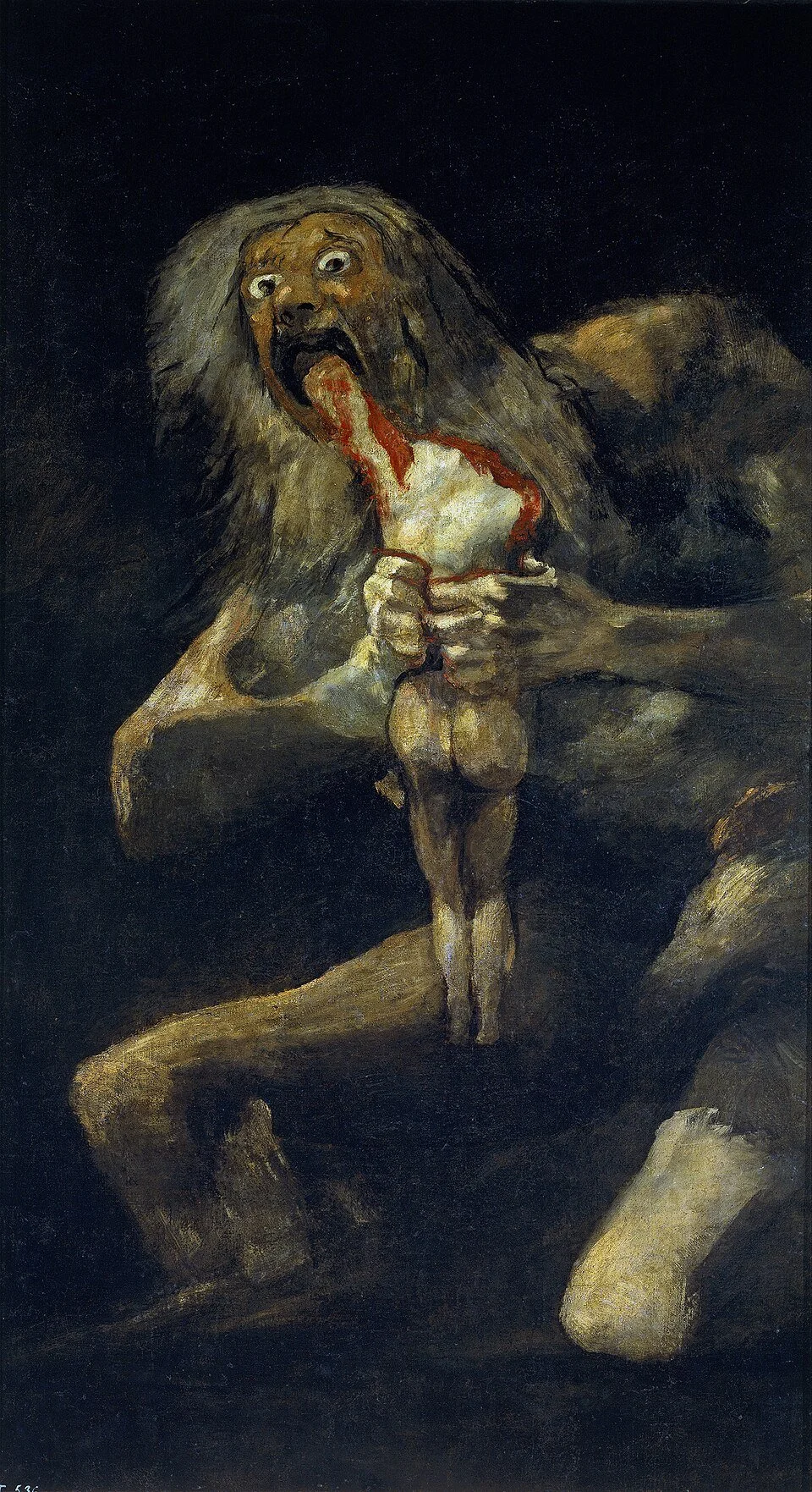
Saturn Devouring His Son
This work is one of the 14 Black Paintings that Goya painted directly on the walls of his house sometime between 1820 and 1823. It was transferred to canvas after Goya's death and is now in the Museo del Prado in Madrid. The Black Paintings are later works by Goya that portray intense, haunting themes, reflecting both his fear of insanity and his bleak outlook on humanity.
The painting is considered a depiction of the Greek myth of the Titan Cronus, whom the Romans called Saturn, eating one of his children out of fear of a prophecy by Gaea that one of his children would overthrow him. Like all of the Black Paintings, it was not originally intended for public consumption, and Goya did not provide a title or notes. Thus, its interpretation is disputed.
The painting's grotesque and emotional nature haunted me when I first saw it. You can interpret the emotions running through Saturn’s eyes in a multitude of ways. There’s desperation, fear, and insanity, to name a few. The way his fingers dig into the body of the figure only adds to the narrative. It feels uncomfortable, but that’s why I will always refer to this as my favorite painting ever when asked.
The Dog (1823)
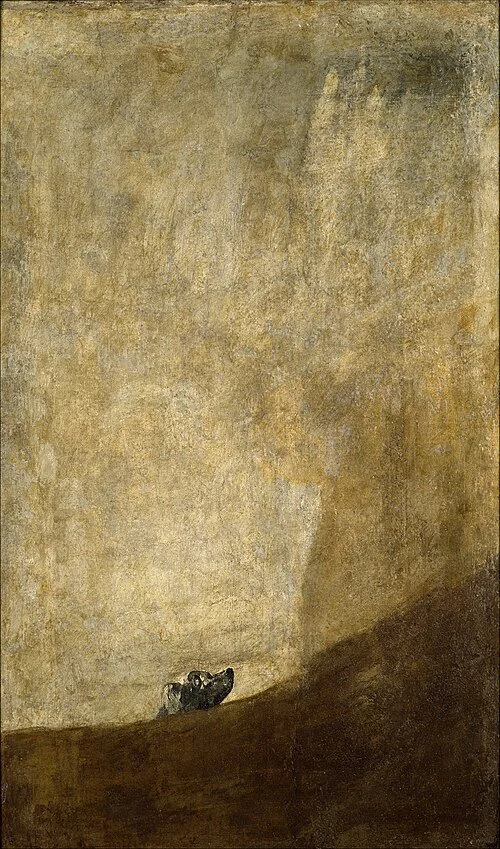
The Dog
This is another one of Goya’s Black Paintings. The painting is divided into two unequal sections: an upper, dirty ochre "sky" and a smaller, sloping, curved dark brown section which fades to black as it slopes to the right. Over the top of the lower section, the dog's head can be seen, its snout lifted, its ears pulled back, and its eyes looking up and towards the right. A faint, dark shape looms over the dog; this is sometimes considered damage or an intentional inclusion, but is generally seen as an artifact of the earlier painting that decorated the wall before Goya overpainted it with The Dog.
The use of negative space creates an uneasy atmosphere. Like all of his Black Paintings, these works leave scholars and artists to form their own interpretations, as he left no titles or notes. To me, the dog is almost drowning in the dark mass. The vast sky creates a sense of overwhelming isolation as the dog looks beyond, at something we can’t see. Perhaps the painting represents Goya’s sense of isolation and abandonment, and how it makes him feel small.
